Key highlights
- Most Indian brands see faster returns from fixing conversion leaks than from buying more traffic.
- A conversion audit maps drop-off across page speed, trust signals, checkout friction and mobile layout.
- A documented engagement produced an 88% conversion lift with no increase in ad spend.
- Buying more traffic is the right move only once the site already converts at a healthy category benchmark.
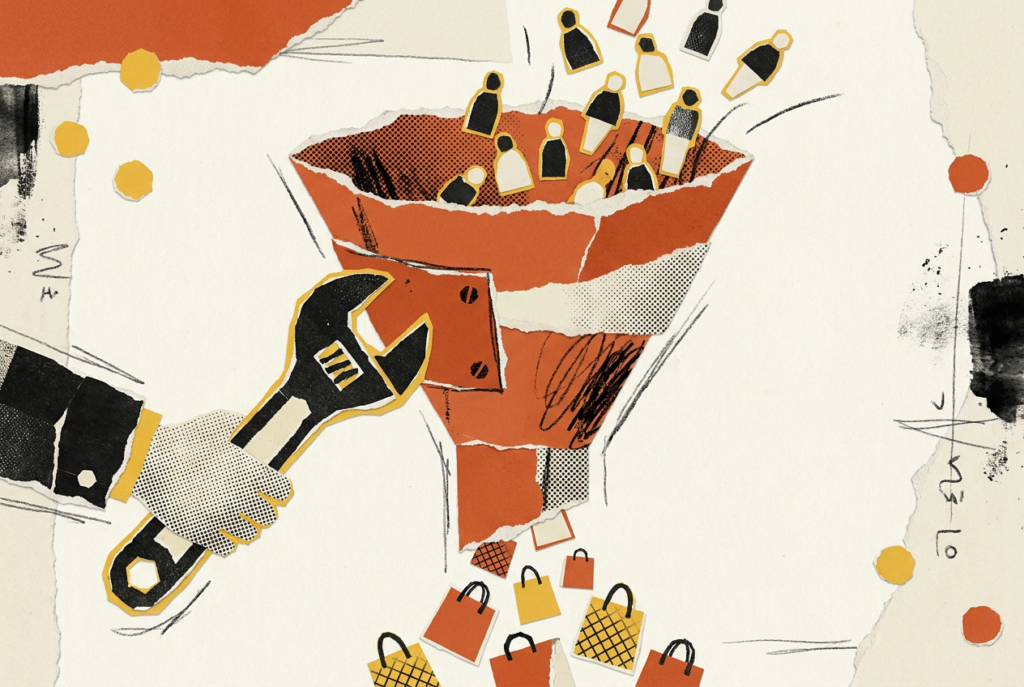
The default answer to slow sales is more traffic, which is like fixing a leaking bucket by turning the tap harder. For most brands the cheaper win is conversion: making the visitors you already pay for actually buy.
The math that changes minds
Double your traffic and you roughly double your cost. Double your conversion rate and revenue doubles while cost stays flat, permanently, because the fix compounds on every future visitor. We rebuilt one D2C store’s conversion path and lifted conversion 88% with zero additional ad spend, three checkout steps became five became three again, but designed around how buyers actually decide. This is the quiet reason CRO is the highest-leverage spend in most marketing budgets: every improvement applies to every visitor you will ever pay for, forever, while a traffic increase costs you again every single month.
Where Indian sites leak most
Slow mobile pages losing buyers before the first scroll. Trust gaps: no reviews near the buy button, unclear delivery and return answers. Checkout friction: forced account creation, surprise charges, too many fields. And message mismatch, where the ad promises one thing and the landing page opens with another. In the Indian market specifically, cash-on-delivery expectations, delivery-time anxiety and mobile-first, data-conscious browsing make these leaks sharper than global averages, which is why a template copied from a US playbook often underperforms here.
What a real CRO engagement covers
Analytics and session-recording review to find where people actually abandon, not where you assume they do. Hypothesis-driven changes, not redesign-by-taste. Speed engineering, because Core Web Vitals are a conversion feature, not a developer vanity metric. And measurement discipline: one change set at a time, judged on revenue. The discipline is what separates CRO from redesign. A redesign changes everything at once and hopes; CRO changes one thing, measures it against revenue, and keeps what wins.
The mistake most brands make first
The instinct when sales are slow is to redesign the whole site, which feels productive and usually is not. A full redesign changes so many variables at once that you learn nothing about which change helped, and it often quietly breaks things that were working. Disciplined CRO does the opposite: it treats the existing site as a set of testable hypotheses and improves it surgically, so every gain is understood and permanent. Rebuild only when the foundation is genuinely broken, not because sales dipped.
Frequently asked questions
How much can CRO realistically improve conversion? It varies with how much low-hanging fruit exists, but doubling conversion is achievable on sites with obvious friction, and even a 20% lift permanently changes your unit economics. The worse the starting point, the bigger the available gain.
Is CRO a one-time project or ongoing? Both. There is usually a concentrated first phase that fixes obvious leaks, followed by ongoing testing that compounds smaller gains. Buyer behaviour and your traffic mix keep shifting, so the work is never truly finished.
Do I need more traffic or better conversion first? Almost always conversion first, unless your volume is genuinely tiny. Fixing the bucket before turning up the tap means every rupee of future ad spend works harder.
When traffic IS the answer
Honesty requires the other side: if conversion is already healthy and volume is genuinely tiny, buy traffic. The sequence matters, fix the bucket, then turn the tap, which is why our performance and web teams work as one system rather than two vendors blaming each other for a number neither fully owns.