Key highlights
- AI product photography builds packshot libraries from existing product images without booking a studio.
- Cost per image is materially lower than a studio shoot, though setup and quality control still take skilled time.
- Accuracy is the real constraint: colour, texture and fine detail need human review before anything ships.
- A real shoot still wins for hero campaign imagery, new launches, and products where texture is the selling point.
The most expensive part of e-commerce used to be the part nobody budgeted properly: photography. Studio days, reshoots, and the meter restarting with every new SKU. AI production has rewritten that math, but the difference between campaign-grade output and obvious AI slop is a system, not a prompt.
How the pipeline works
Serious AI product photography starts before generation: locking a visual system of angles, lighting logic and surface treatment so image one and image sixty look like siblings. Then the pipeline is tuned to the category and its hardest details, metal reflections, fabric weave, glass transparency. Every output passes a human quality gate calibrated to campaign standards, and anything below it dies before the client sees it. We documented the full approach on our AI Production service page.
The reason the system matters more than any single tool is consistency. Anyone can generate one good image. The commercial problem is generating sixty that share a lighting logic, a shadow direction and a colour treatment so they sit together in a catalogue, a grid and an ad set without looking like they came from sixty different photographers. That coherence is engineered up front, in the visual system, not rescued afterwards.
What it costs versus a studio
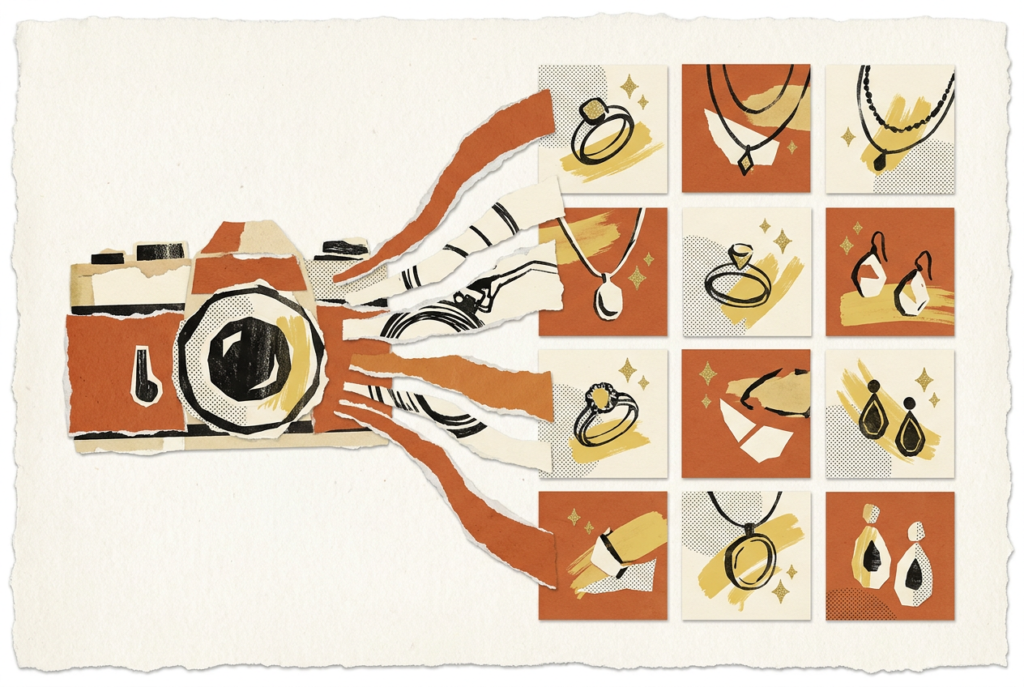
The honest comparison is not per image but per usable library. A traditional shoot prices per day and per reshoot; an AI pipeline prices the system once, after which the marginal image approaches zero. Our 66-product jewellery library shipped in days without a single studio booking, and now extends on demand. The economics change the way you plan: adding a new colourway, a new format or a seasonal set stops being a budget conversation and becomes a same-day task.
The accuracy question, answered honestly
The fair objection to AI product photography is truth. A customer who receives a product that looks nothing like the image returns it and stops trusting the brand, so accuracy is not a nicety, it is the whole game. This is exactly why the human quality gate exists and why it is calibrated against the physical product, not against what looks pretty. Where a model cannot render a detail truthfully, the honest answer is to shoot that detail for real and composite, never to ship a flattering lie. Any vendor who treats accuracy as optional is a liability, not a saving.
When a real shoot still wins
Categories where photographic truth is legally or emotionally critical, hero campaign imagery, and founder or team photography. The sweet spot for most brands is hybrid: one compact real shoot for truth, AI for scale, variants and formats. Food that must look exactly as served, skincare where texture is the promise, and anything with a regulatory dimension are where a camera still earns its day rate. The skill is knowing which images belong in which lane.
Questions to ask any AI production vendor
Who checks accuracy against the physical product? What happens when the model cannot render a detail truthfully? Can they match your existing brand photography? Vendors without crisp answers are selling prompts, not production. Ours are on the record, and the FAQ on the service page answers the hard ones first.
Frequently asked questions
Will AI product photos look fake? Bad ones will. A systemised pipeline with a human quality gate produces images customers cannot distinguish from a studio shoot, because the tells that give AI away, wrong reflections, warped text, impossible shadows, are exactly what the gate is built to catch and kill.
Can AI match my existing brand photography? Yes, when the visual system is built to your reference. The lighting logic, angles and treatment are locked to your existing library so new images extend the set rather than clash with it.
How many products can a pipeline handle? Once the system is built, scale is the easy part. Large catalogues are where the economics work hardest, because the fixed cost of building the system is amortised across every SKU. This is also what makes marketplace listings viable to produce at volume.